

A Deeper Culture
the story rocking Scottish politics

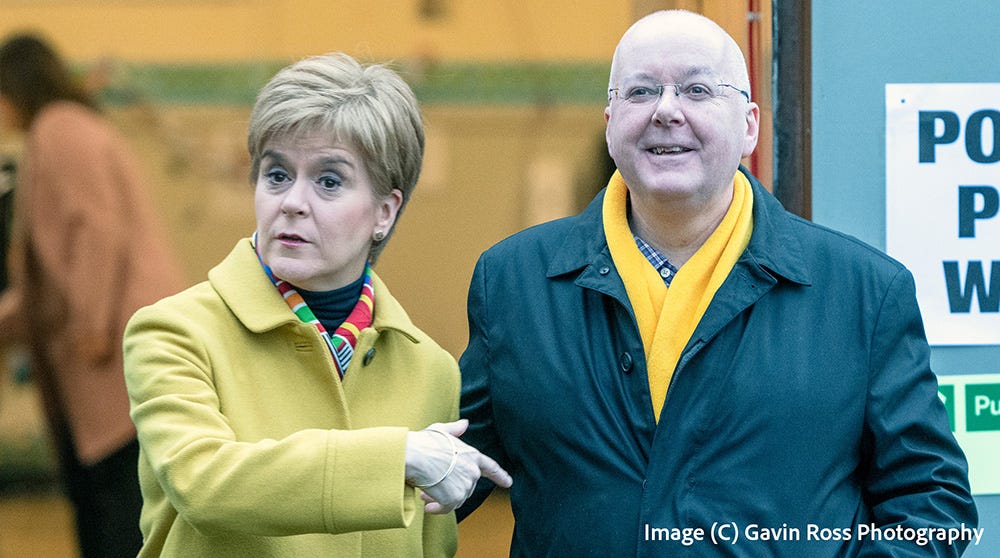
Earlier this week, former SNP chief executive Peter Murrell admitted in Court his embezzlement of more than £400,000 from the political party he headed. His now-estranged wife, Nicola Sturgeon was the leader of that party and First Minister of Scotland. Murrell’s admission of guilt, however, is not the end of the matter. In fact, it seems to be an inflection point in the story, beyond which there is a greater freedom to ask difficult and quite searching questions.
Those questions seem to be asking two distinct things - firstly, how is it possible that Nicola Sturgeon had no knowledge (nor even a suspicion) of what her husband was doing?; and secondly, what was the culture that allowed this embezzlement to take place?
Consequently, the story has been ‘the talk of the steamie’ as they say in these parts; it is a major political story and one which is very much in the national interest since the political party at its centre have just been returned to Government here in Scotland. The present First Minister, John Swinney, is also at the heart of this long-running saga because he was the deputy First Minister throughout the period in question.
Regarding that first question - it is established that Ms Sturgeon has not been a part of any criminality in this matter. Although arrested much earlier in the Police investigation, she was released without charge and no proceedings have been issued against her, nor is she under any investigation. Her lawyer has released a number of statements this week and has decried the “armchair detectives” who cannot fathom how it is possible that there was no suspicion in her mind that something might be amiss. Be that as it may, a great many people seem to have difficulty accepting her repeated emphatic denials - they point out the appearance of two very expensive cars, not to mention a lengthy list of other luxury goods such as a Mont Blanc fountain pen. Despite Ms Sturgeon’s protestations, the suggestion that she must have known something or at least had some suspicion, is persisting.
Earlier this evening, speaking to a journalist, Nicola Sturgeon spoke about all this. She conceded that she could understand why people thought and believed as they did - but again dogmatically denied any knowledge or suspicion of her now-estranged husband’s misdeeds.
She said -
“Just as other people have been, I have been deceived. I have been misled, I have been lied to and I have been betrayed, and I won’t be the last woman who has been betrayed by her husband.. this is a long-winded way of saying I am not OK.”
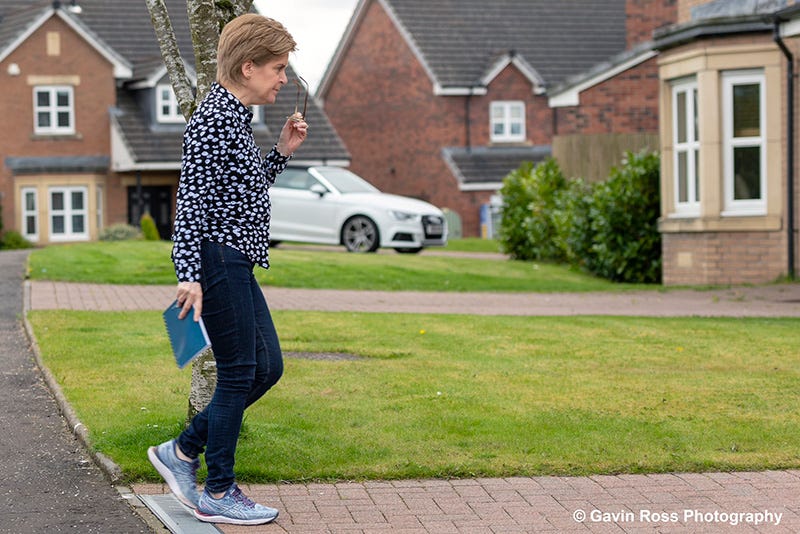
Earlier this week, former SNP MP Joanna Cherry was interviewed on television and reported on by the BBC and in the course of this, she was clearly upset and aggrieved. Ms Cherry said to the gathered reporters that Ms Sturgeon had shown “a remarkable lack of curiosity” about the financial position of the party she had led for so long.
Questioned by journalists, Ms Cherry said -
“I would like to see a properly independent inquiry into how this was allowed to happen and in particular into why the efforts of those of us who were elected to get to the bottom of the party’s governance and financial mismanagement were frustrated from doing so, and frustrated from doing so in pretty unpleasant circumstances..
It wasn’t just that we didn’t get an answer to our questions - we were demonised for asking the questions and one by one we all resigned from the national executive committee.”
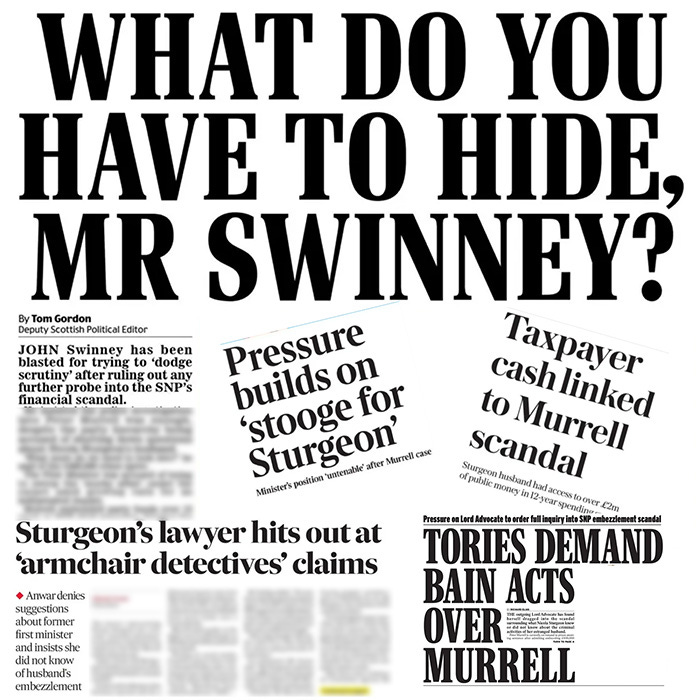
For the third consecutive day, the national newspapers have focussed very heavily on the whole sorry story. But the particular questions being asked now are different to those being asked on Tuesday.
Then, it was about the details of the case and that extraordinary list of quite extravagant (even for the chief executive of a political party who is married to a First Minister) list of luxury goods purchased with embezzled funds.
Today, the focus has moved to the culture in which this embezzlement took place. One bold headline (bold both literally and metaphorically) enquired of the present First Minister - ‘What have you got to hide, Mr Swinney?’ The clear suggestion is that he had knowledge - at least, to some degree - that something was wrong.
Earlier today, the first ‘First Ministers Questions’ of the new session of the Scottish Parliament took place in Holyrood. It was, perhaps not surprisingly, something of a fractious affair.
Taking a quite assertive approach to the whole matter, former dentist and current leader of Scottish Labour, Anas Sarwar, said this -
“Questions remain about the deeper culture; a culture that is not just a hallmark of how the SNP run their party, but also how they govern the country - a culture of secrecy and cover-up, where the public are not told the truth, dissenters are vilified, and careers destroyed; where protecting the party and the people at the top, is more important than the country.”
Despite the attempts of the First Minister to deflect the questions coming from his opponent, to shift attention onto election results or anything other than the matter at hand, still the questions linger in the minds of just about everyone.
The primary reason for that is that over the course of many years, the SNP government have gained a strong reputation as a party of secrecy where questions cannot be asked and no light is allowed to shine inwardly. An example of this is a short video clip from a couple of years ago, which seems to have leaked from within the party. In it, Nicola Sturgeon tells the other only participants very clearly that there is no problems with party finances and they should be careful about suggesting otherwise as that would affect donations to the party. Of course, the problem is that there most certainly was a problem. And it was hiding in plain sight.
Today, and over the course of this week, John Swinney has been at pains to keep the attention on the criminality of one man - all his fault, he’s to blame, no-one else, nothing to see here, move along now. But no-one really believes that to be an accurate version of reality. And that was the point being made today at First Minister’s Questions. Sarwar spoke about the “SNP machine which operated without scrutiny” - and this lack of oversight being a prime reason for what followed.
The leaders of Scottish Labour and the Conservatives have called for a Parliamentary Inquiry into the political culture in which these events took place, looking at all the issues surrounding them, such as political scrutiny and transparency - or the lack of these.
But the First Minister, John Swinney, has stated clearly he will not support the call for such an inquiry. He does not want the focus to move to his governing party, particularly as it begins its new reign in power.
“Criminality is the source of this, there is nothing a Parliamentary Inquiry can add” he said yesterday in the Scottish Parliament.
I have a feeling his views might change as the pressure continues to mount.
What is abundantly clear is that the media have no intention of letting this story die quietly. Looking at the BBC News website this evening, quite a number of pages are dedicated to this story, each approaching it from a different angle and asking a pertinent question.
This story is not going away - and nor should it.
If you enjoyed this article, please subscribe to this Substack. It’s free.