

A Symphony In The Dark
a masterpiece in elevated horror

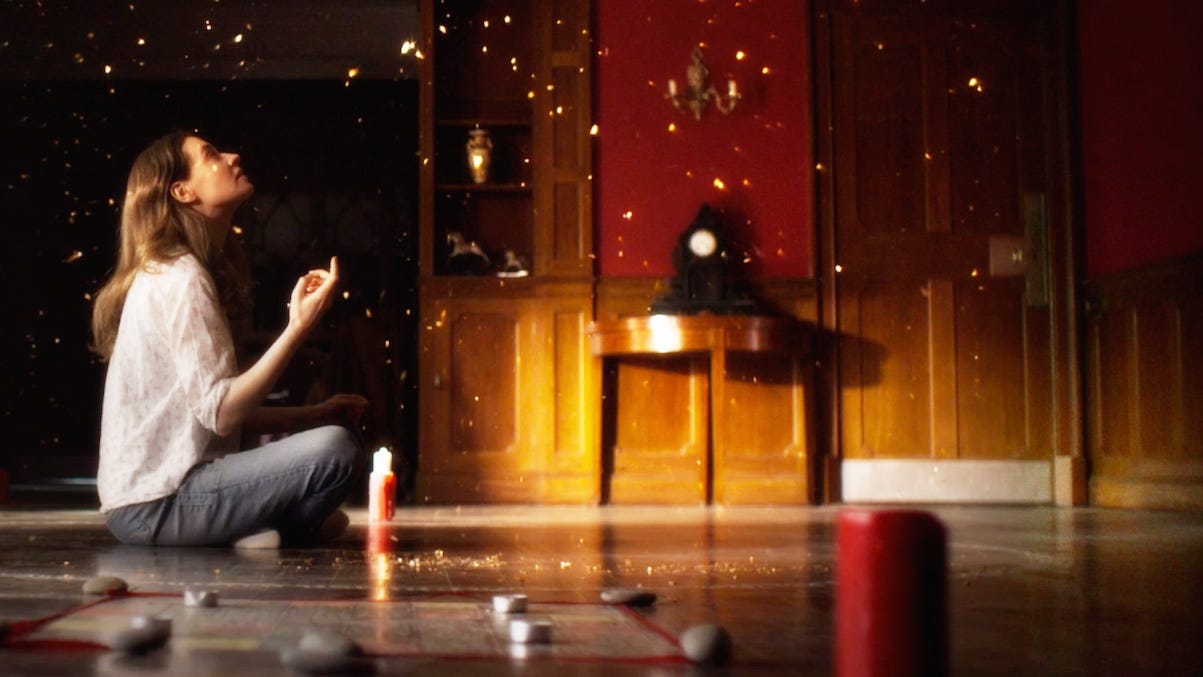
As a very long-time fan of the genres of both horror and the occult in book and film, it is rare for me to find something which crosses into both places exceptionally well - but “A Dark Song” does precisely this.
I had read about Liam Gavin’s 2016 independent film on a few occasions - and the reviews were always very positive indeed. But I had then forgotten all about it. Until a few days ago, when I began seeing mentions of it once more. Reading more reviews, none of which was negative, I thought it was about time I had a look. I downloaded the film and watched it the other night.
I remember back in the 80s I visited the local library often and devoured all the books I could find on all things mystical, mythical and occult, all those practices which spanned the two esoteric paths of the left and the right. Many of the books I read examined the practice of British witchcraft from the 1600s onwards; others looked at the mystical societies of the Nineteenth and early Twentieth Centuries - notably, the Hermetic Order of the Golden Dawn and one or two others, such as the Theosophical Society.
Famous Names
As I worked my way through these obscure volumes - many of which I had to specially request, as I came upon one especially recommended work or another - I came to see a few names popping up frequently (and sometimes often) in several disparate sources. One such name was that of Madame Helena Blavatsky, a Russian occultist who was active in the latter part of the Nineteenth Century. Another such name was that of Samuel Liddell MacGregor Mathers - one of the three founders of the Golden Dawn, but later expelled from the Society. A third name from those days was that of Aleister Crowley - “the most infamous man in the world”, as he was sometimes called.
Now, the late Mr Crowley was widely known as a serious dark occultist and ritual magician, an attribution which he rather enjoyed and did everything in his power to encourage. He bought an 18th Century estate called Boleskine House, on the south-eastern shores of Loch Ness in Scotland. It was there, primarily, that he practised his arts and magical workings. The house has since been in the possession of rock stars and others, but it suffered two fires and was almost completely destroyed. A trust was formed to restore the house and it finally re-opened fully in April this year.
Aleister Crowley wrote ‘The Book Of The Law’ - claiming this had been dictated to him by a supernatural entity - and this was the basis of a religion he founded, called Thelema; and he went so far as to establish an ‘Abbey of Thelema’ in Sicily. The core tenet of Thelema is that each person has a ‘True Will’ - which they are enraged to discover and explore - and this co-operates with the ‘Divine Will’. This process he called ‘the Great Work’ or the ‘attaining of the knowledge and conversation of the Holy Guardian Angel’ - and this was best done by means of something called the Abramelin Ritual.
Ancient magical grimoires dating back centuries are the source of the text of this ‘Abramelin Ritual’ - and in particular, a text written in Germany in 1458. An English-language version of the text (entitled ‘The Sacred Magic of Abramelin the Mage’) was published in book form in 1897 by Samuel MacGregor Mathers (see what I mean about those same names?) and it was this which caught the attention of Crowley and - in later years - many others.
This book is essentially a magical text book and the particular rite it describes is a summoning ritual - the intention being to summon the ‘Holy Guardian Angel’ sought by Crowley. The ritual itself is enormously complex and asts for at least six months, often longer. It works through various phases, beginning with the physical detachment and (eventually) spiritual purification of the practitioner. Gradually ascending through various ‘circles’ of practice, each designed to achieve a particular and very specific aim - the practitioner eventually comes to a point in the ritual where one intention remains - to successfully summon a Guardian Angel. All the while, great strides are taken to protect the ritual magician - spiritual doorways are being opened and the entities noticing this and seeking entrance are not always the ones being invited.
“Wow. Literally, A Dark Song was intense as all Hell.”
- The Horror Society
Back To The Film
So, you may be asking, while all this is incredibly fascinating, what does it have to do with a film called “A Dark Song”? The answer is surprisingly simple. The film is a representation of the living out of the practising of the Abramelin Ritual.
I have to note here that whoever did the research for “A Dark Song” did it extraordinarily well. Not only did they know the structure of the Ritual, but they seemed to have an understanding of the intentions of the parts of the Ritual as well as the rite in its entirety.
Perhaps more exceptional was that an ancient magical ritual could so successfully form the basis of a film and still retain the great interest of the viewer. Yet the plaudits this film has consistently received demonstrate that this is the case.
Interwoven with this element is the developing relationship of the two people who are undertaking the practice of this dangerous rite. These two characters are the entire cast for 98% of the whole film.
Sophie is the mother of a dead son. She has sought out a ritual magician called Henry Solomon, who is deeply familiar with the Abramelin Ritual, so that she might “hear my son’s voice once more”, as she tells him. Solomon is at pains to make her understand just how dangerous the ritual is and how much it will cost them both physically and spiritually. Sophie has rented a large isolated house set deep in the Welsh countryside. Solomon draws a protective magical circle of salt all around the boundary of the house and tells her, before sealing the circle, that this is the last chance to back out. But Sophie insists they proceed and so the circle is closed.
And that is where the problems begin.
From Darkness To Light
In the midst of a deeply abrasive relationship in the first stages, Sophie must comply with what Solomon demands. The viewer is left wondering if this is all a con on his part, even though he says he is not remotely interested in the large sum he is being paid. He tells Sophie his plan is to live quietly between now and death, just to experience some peace, since he is certain he will be damned - “most of us are damned”, he tells her. We come to realise that Solomon is indeed exactly what he says he is - an authentic ritual magician who has previously undertaken this ritual three times, successfully on two of those occasions.
What comes to light is that Sophie has not been entirely honest about her intentions for the ritual - she has told him “the truth” (that her son is dead and she wants to hear his voice), but not the entire truth. Her son was murdered by two teenagers undertaking magical ritual. Now imprisoned, she is seeking supernatural vengeance against them both. Her heart, then, is filled with anger and hatred and an inability to forgive. And it is this hatred which allows the entrance of darker forces in that isolated house, notwithstanding the spiritual protections employed by the magician.
Solomon determines that Sophie needs to be purified spiritually so they can proceed safely. To accomplish this, it is necessary to immerse her thrice in water, whilst he recites magical ejaculations, praying that she might “touch the Void, the Nothingness”. And on the third immersion, he deliberately drowns her - in those moments of clinical death, she does indeed ‘touch the void’. He performs CPR and revives her, telling her that she is now “born again”.
Gradually, odd things begin to happen - things which Sophie cannot explain. She hears strange murmurings without any source; finds flowers in the hallway of this house they have not left in months; and they both experience a very loud and deliberate thump from beneath the floor where they are continuing with the ritual. Later, as she is within one of the five spiritual circles drawn on the floor, a shower of gold leaf materialises and descends upon her. Here initial desire to hear her son;s voice is fulfilled - he speaks to her from behind a (literal and metaphorical) closed door, which she refuses to open. Shadows appear also.
As a result of a scuffle, Solomon is pierced by a kitchen knife; the wound becomes badly infected and he subsequently dies slowly. Sophie leaves the house, only to return and complete the Abramelin Ritual. Before doing so, she is assaulted by the souls of the damned, who drag her down to the basement and one of them cuts off her finger. On the basement steps, a light begins to glow.
Sophie frees herself from the damned and ascends the steps upwards - a clear allegfore of her ascent from hatred to something far better. Following the light, she goes into the room of the Five Circles. There, in the Fifth Circle, is the Guardian Angel - huge, shimmering in golden light and speaking in a way we cannot hear properly or understand. Approaching him, Sophie makes her request - “I want to be given the power to forgive”, she asks. And it is given to her.
She has moved from hatred of those who killed her son, to forgiveness of them; and now, for her own soul, there is finally some vestige of hope - it is no longer assured that she is amongst those souls to be damned, as Solomon had previously attested.
Final Thoughts
“A Dark Song” is different to most other horror films.
Where the usual plot for horror films is that the protagonists find themselves unwittingly involved in something dark, here the darkness has been deliberately sought. As the movie poster proclaims, there are “two people who should never be alone together” - and yet ultimately, what emerges from the human heart is love and light, not the darkness of hatred. Redemption has been found.
The occult source material upon which the film is structured is given very considered - almost reverential - treatment. There is none of the usual skipping-over of detail - on the contrary, that very detail is laid out explicitly before the viewer. But the warning is clear both in the words of Solomon and from the film itself - some things are better left well alone, for unexpected consequences often follow and cannot be controlled.
This is not anything like the generally-accepted shock horror of most present day horror films. There are not really any great bloody moments, save the severing of the finger. There is no levitation in a room of ethereal smoke, nor is there a long-taloned monster shredding through the cast with glee. Here, the horror comes from the deep sense of foreboding which begins at the very start when the characters’ intentions are made known, and it builds powerfully all the way through, each step of the ritual leading us deeper into a sense of what is about to happen and leaving us with a chilled dread.
This is a slower-paced film than most - it is not two hours of blood and guts and fast action. Instead, it is a contemplative film. From the outset, you find yourself wondering what you might do if you were Sophie? If you could - would you undertake the ritual? Would you seek vengeance for a murdered child?
I have read several reviews of the film which recommend a second viewing, as this is when much of the real detail becomes apparent, and a true reverence for the film emerges. And so I shall give it that second viewing.
This film might indeed be a symphony sung in the dark - but the final notes ring out in the warmth of supernatural golden light. And it this light with which the viewer if left.
“A Dark Song” is, without doubt, one of the very best horror films I have seen - it will not appeal to everyone, but to those who like this sort of subject matter, you won’t find anything better.
If you enjoyed this article, please subscribe to this Substack. It’s free.